
Research
In the Stuart-Fox Lab, we primarily study the evolution and diversity of animal coloration because it provides rich insight into biological processes generating current diversity. This page provides an overview of our research areas.
Biological optics and visual ecology 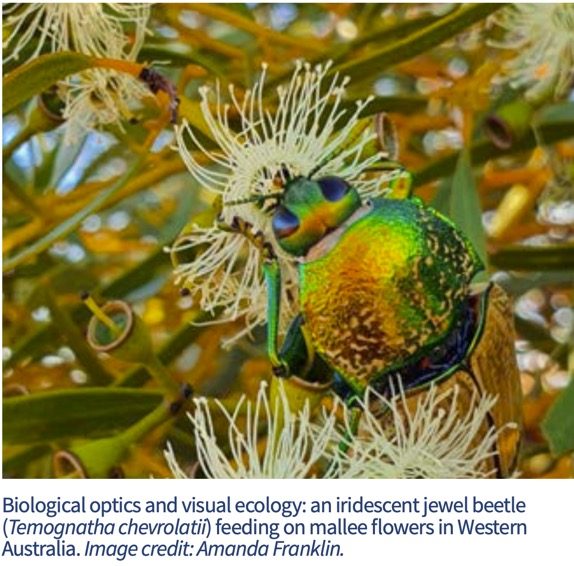
We study the mechanisms that produce vivid colours and diverse optical effects, such as iridescence, metallic appearance and highly reflective surfaces. The biological function of these complex optical effects depends on how they are perceived, so we also study visual perception using a combination of visual physiology, behavioural experiments and computational modelling.
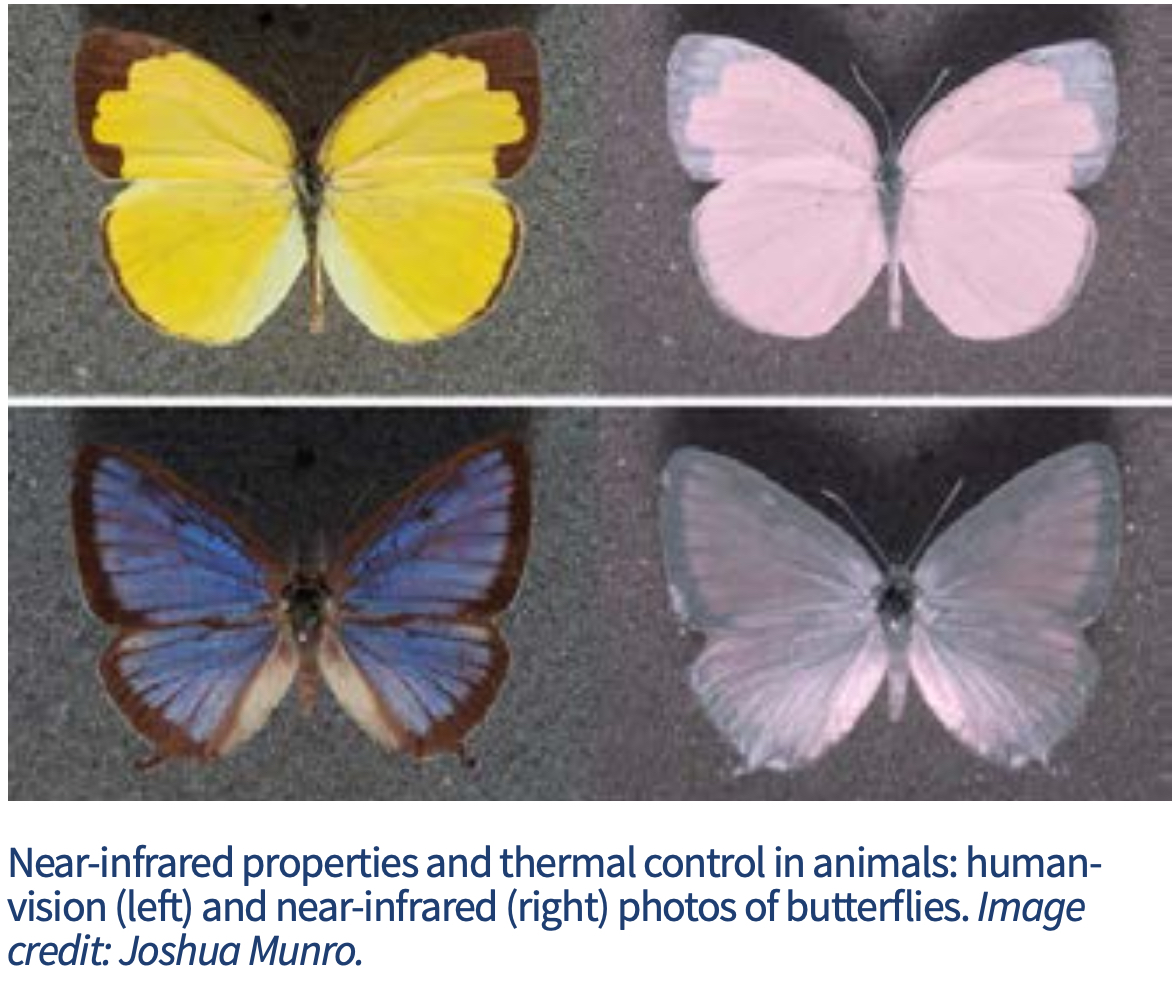
Near-infrared properties and thermal control in animals
More than half of the energy in direct sunlight falls within near-infrared (NIR) wavelengths, beyond the limit of human and animal vision. Absorption of solar radiation in these wavelengths significantly affects heat gain, yet almost nothing is known of the diversity and mechanisms of near-infrared properties in animals, let alone their adaptive value. We are investigating the mechanisms controlling infrared reflectance in beetles. We also study the relationship between climate and reflectance of both visible and near-infrared light in a range of taxa, from reptiles and birds to butterflies and beetles.
Bio-informed technologies and design
Structural colorants are used in a vast array of manufactured goods, from banknotes to plastics and paint, but are produced unsustainably from non-biodegradable materials. Nature produces the most vivid structural colours of all using just a few abundant, biodegradable materials. Natural materials have simultaneously been fine-tuned for other essential properties such as wear resistance, water- repellence and thermal control. We are collaborating with scientists in several other discipline areas to design better, multi-functional and more sustainable coloured materials informed by biology.
 Stuart-Fox Lab | Devi Stuart-Fox
You must be logged in to post a comment.