
Science Marquee 2023 – IllumiNATURE
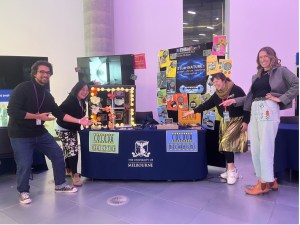
Each August brings us back around to UniMelb’s annual Science Festival, hosted by the Faculty of Science as a part of National Science Week. Amongst the plethora of exciting events held at the National Science Gallery, lab members Laura, Amanda, Avichal, and Kei-Lin had a chance to showcase the lab’s colourful research.
With the theme for 2023 being “Collaboration-Innovation-Impact”, our team created an interactive exhibition for the Collaborate to Innovate Expo. In a stroke of inspiration, our exhibit was titled “IllumiNATURE: animal vision inspires innovation”. Herds of schoolchildren and families poured in to hear about colour research, and we showcased different aspects of colour inspired by the natural world, including perception, mechanisms, functions, and bioinspired technologies.
For colour perception, we had guests use UV torches to spot hidden patterns in our flowers, which we had artistically hand-painted using blacklight reflective paint. The patterns revealed by UV light represented what a UV-seeing animal like a honeybee would see. And although the ability to see UV might make it seem tempting to want a honeybee’s vision, it turns out they have very poor visual acuity, meaning it is hard for them to resolve shapes at a distance. We demonstrated this to guests with some printed reels showing the resolution of what different viewers (like a honeybee) would see at a range of distances.
 A honeybee… versus what another honeybee would see from just 10am away. Pfft, and I thought my eyesight was bad! Beautiful image courtesy of Seb!
We highlighted some structural mechanisms of colour using 3D movie glasses – these are left handed polarised in one eye, and right-handed polarised in the other. We had guests look through them at a curated box of brilliantly coloured beetles (and one butterfly), all of which utilise structural colour. Of special interest were the scarab beetles, which have elytra that reflect left-handed circular polarised light. In one eye, you can see the flashy glossy colour, but in the other you can see only a drab brown. Fascinating! Feedback from kids included “how is this even possible?” and “wow shiny… what’s the point?”.
To answer the first question, we pointed them to our billboard, which had magnified images displaying the nanostructures that produce these and many other brilliant colours. Scarab beetles have slinky-shaped nanostructures that reflect the light back in spirals, and we had some actual slinkies on display to demonstrate this point. Our billboard also featured information about many fun bioinspired technologies, such as heat-retaining textiles made from hollow fibres inspired by a polar bear’s hair.
And why shiny? To explore functions of colour, we presented videos by Patricia Henríquez-Piskulich and Seb Judkins, highlighting the function of gloss in antipredator defence. These videos were from behavioural experiments and featured a rainforest mantid struggling to catch a glossy target. A jumping spider was shown doing a similar thing, jumping and missing the glossy target. It seems that these predators might be dazzled by shine when fast moving prey are glossy (see Patricia’s newly published paper!).
Thanks to the huge effort of our team, we got the opportunity to engage with the public and give them a taste of just some of our fabulous research. After much preparation and careful planning spearheaded by Laura, we could call the day a glamorous success. And, as I like to believe, we hopefully inspired some kids to get involved in science.
Post by PhD student, Kei-Lin Ooi.
 Stuart-Fox Lab | Devi Stuart-Fox
You must be logged in to post a comment.