
Feral cat camouflage with a twist

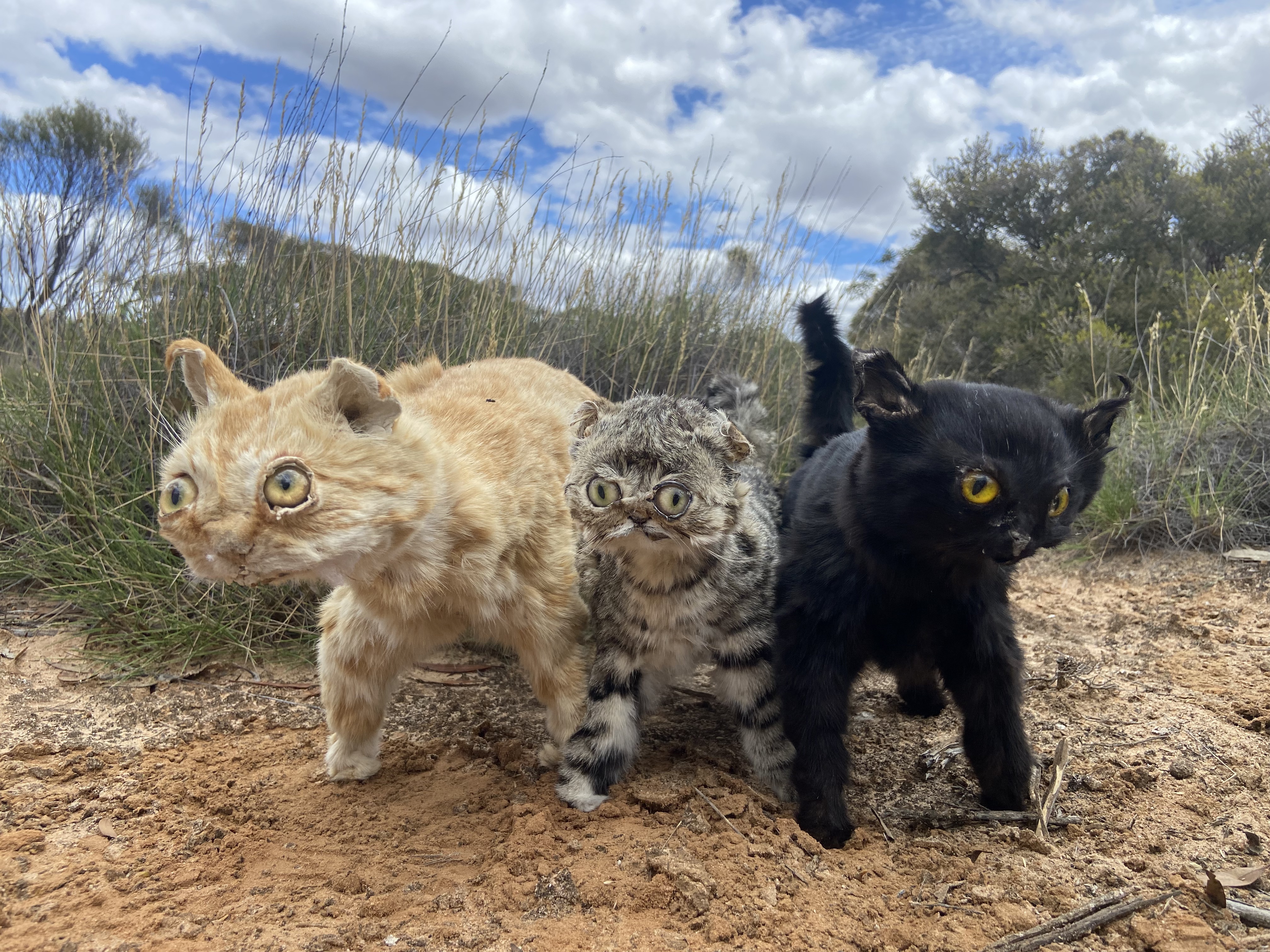
When I convinced Devi to accept my humble labour at the Stuart-Fox lab, I expected to spend six months in a spooky laboratory basement, endlessly hacking at the mind-numbing tasks demanded by horrendously outdated analysis software. Instead, I found myself venturing into the wilderness, accompanied by a crate of uncanny entities: taxidermized feral cats, crudely crafted by my preceding intern from the corpses of unfortunate kitties. Once proud felines, gorging themselves on innocent native wildlife, are now stuffed in a box (carefully, Devi, don’t worry) to be ferried to photoshoots on a morbid travelling catwalk.
The purpose of this activity, which does well to convince passing bushwalkers to avoid me at all costs, is to see if the different coat morphs of feral cats – i.e. orange, tabby and black – might have camouflage advantages in different Australian habitats. If so, this could explain why we observe different frequencies of coat colour morphs in these habitats: a phenomenon that may be an example of natural selection occurring at a rapid pace, driven by the higher hunting success of better camouflaged cats.
To collect this data, I used a camera adapted to capture a wide range of spectra along with Visible / UV light filters and reflectance standards. With the grace of Victoria’s famously consistent lighting conditions, I used these to take standardised photos of my squadron of monstrosities across a range of different backgrounds. After a healthy amount of suffering in the dark lab basement, these images are then run through the QCPA (Quantitative Colour Pattern Analysis) framework; a handy feature of MicaToolbox. This produces a plethora of metrics that describe how well each cat is camouflaged in each image. Where are my results, you ask? Pending!
Post by Lois, intern extraordinaire
 Stuart-Fox Lab | Devi Stuart-Fox
You must be logged in to post a comment.