
Science is everything
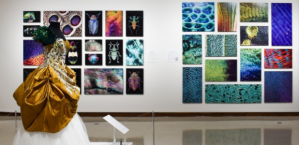
Beneath the liquid splendor of the lights
We live a little ere the charm is spent;
This night is ours, of all the golden nights,
The pavement and enchanted palace floor, […]
A strain of music thru an open door
Extract from “Broadway” by Sara Teasdale
Life is much more than work. So, when I say “Science is everything” I don’t mean it is the only thing in our lives. Rather, I think science is decorated with little inlays of human-ness, such as arts, emotion, history and creativity. This isn’t a new idea. Experiments in fundamental sciences seem objective because natural phenomena are measurable. However, any experiment comes from a scientist’s mind, shaped by their identity. My recent trip to the U.S. made me realize that science can’t be separated from people, just as scientists can’t be separated from their cultures and stories.
In early April, I visited the Air Force Research group in Destin, Florida, to study light polarization on beetle shells. I met a great team of scientists working on vision and colors in various organisms. I learnt lots! I tried new R tricks, saw the inside of an SEM, and got tips on calibration in spectral measurements (beware! Machines are foolish…). I also “stole” ideas for storing specimens and lab tools (buahaha!). I learned how to measure a beetle’s circular polarization: It involves four filters with slits that let light through in only one direction, a mechanism to rotate these filters, and a spectrometer to measure the reflected light on each step of the rotation. After some calculations, we can tell if the beetle reflects already polarized light or if it twists the light path making it polarized. Cool, huh? Finally, we collected 1,406 spectral curves, now on my USB drive, patiently waiting for me to embark on a new coding adventure.
If you are still reading, get ready for the fun! Apparently, Britney Spears has a house in Destin – no surprise given the clear skies and sunning beaches! I tried traditional Southern U.S. food. I liked hush puppies and surprisingly loved fried okra – despite my usual hate for it. “Fried” is the key. I experienced a mild storm, witnessed a 0.75 magnitude solar eclipse (of the heart according to our party hats) and made new friends. Including two charming and fun people, condemned to be overshadowed by the cuteness of their doggos. I was introduced to Farkle and – ironically – was great at it! And, I discovered Dr. Nate has personally met one of my favourite artists, Soo Sunny Park, whose whimsical and colorful work I’ve admired since 2013 (foreshadowing horn). It happened during his beetle inspired art exhibition in collab with Luisiana Art and Science Museum – 2021. Inspired and inspiring, I hope to one day be part of a creative initiative merging art and science.

Afterwards, I headed to New York, to study the thermal properties of beetle shells with Prof. Nanfang Yu at Columbia University. I tried using a Focused Ion Beam for the first time. Many attempts are needed to determine the perfect settings to mill the material without melting it. I also measured how the beetles’ hardened wings interact with waves longer than 1 micron, which are heat waves instead of light waves. The set up was fascinating, involving a ceramic plate that heats up to produce the waves, a Fourrier transform spectrometer and numerous mirror-based optical components (like those in telescopes) because lenses cannot handle long waves. Working with Prof. Nanfang and his team was enjoyable, and full of illuminating conversations about experiments, butterfly vision, data interpretation, academic careers and… our pets. As a result of this visit, I now have another set of images and spectral curves on my USB waiting for some love.
New York is a mythical city. With its tall buildings, crowded streets and a pacing that suggests something big is just about to happen. I listened to the audiobooks “black is the body” by Emily Bernard and “On savage shores” by Caroline Dodds Pennock while wandering the streets. I attended two soul music concerts in Harlem that made my heart shake with emotion, thinking about how music can reunite and bring hope. For the first time in my life, I was moved by modern art (at MOMA). I also saw a spectacularly kitsch icon of the 90’s childhood and learnt about the triplet that turn NY into the “capital of the world” (at the NY history museum): the bay, the Erie canal and the brilliant idea of keeping ships active on a regular schedule. I am very happy to report that many dioramas in different museums are now being annotated to bring visibility to the Lenape, the original peoples of Manahatta (now called Manhattan but originally meaning “the place where we get bows”) as a rebellion against colonial narratives. In the natural history museum, I saw rocks from the Moon and Mars, human remains, dinosaur remains, and beaver remains, amongst other biology wonders… I stared at Tiffany’s showcase with my coffee and croissant at hand for a bit of a dramatic effect. I acquired an awesome book about the local fauna… a guide to pigeon watching. And finally, I went to two Broadway plays and met Daniel Radcliffe. Technically, he did not meet me, but I think it still counts.
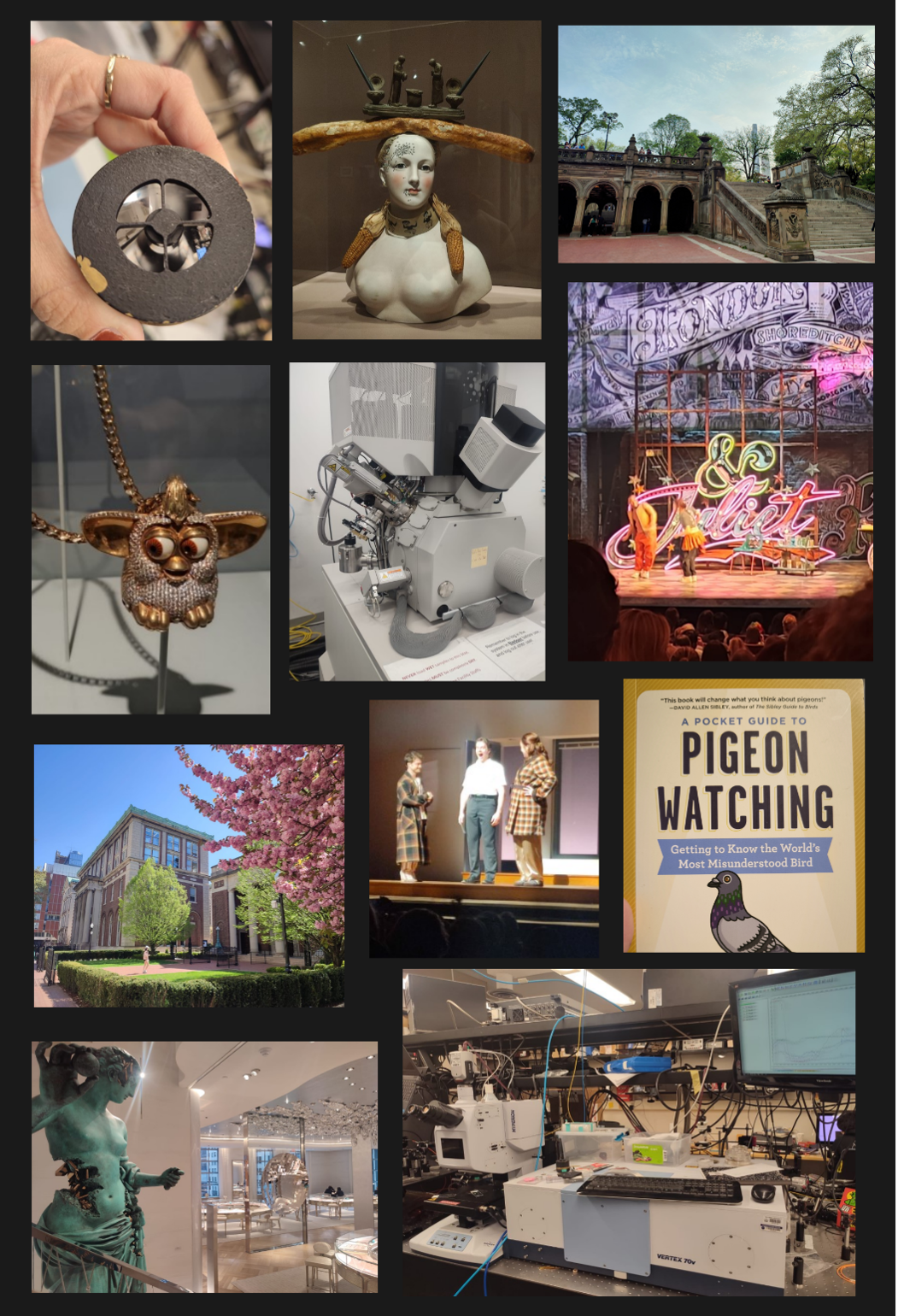
This text was written in two inks. If you are a scientist and liked the paragraphs in this colour, you are proving my point! Science is everything because we, the scientists are influenced by every little detail in our surroundings that can move our heart. I refused to label the images in this piece, hoping the chaos adds to my argument. I love thinking that the science I do, carries all I have ever lived and thought. This means that the interactions with the people I met in my trip and the new worlds I saw, will forever change the way I see beetles, light, and life. How illuminating and powerful it is to travel.
Post by Laura: postdoc, adventurer, poet.
 Stuart-Fox Lab | Devi Stuart-Fox
You must be logged in to post a comment.